
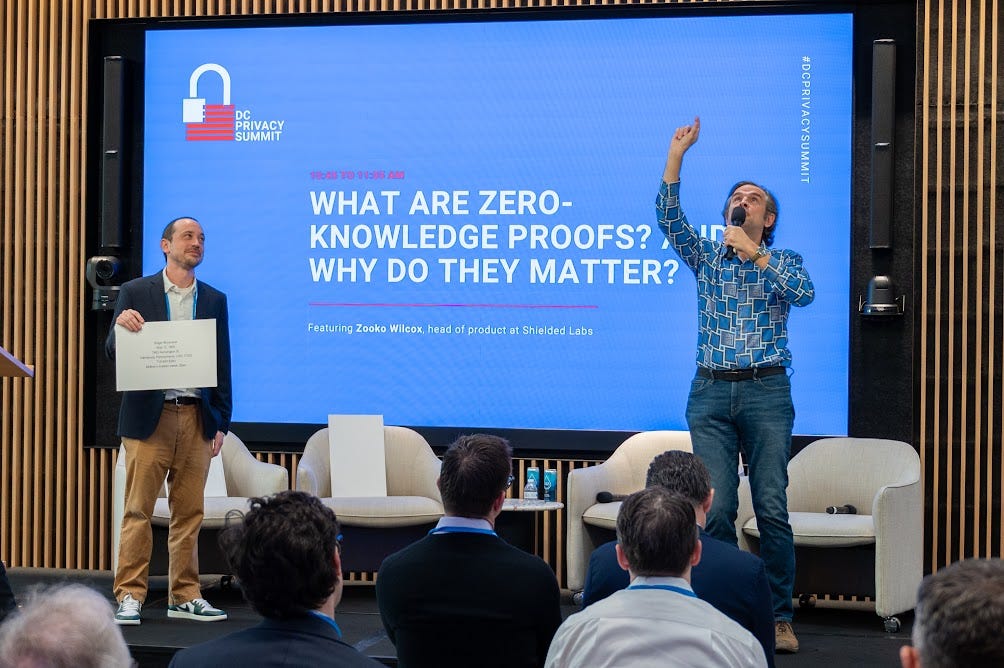
Hello! We’ve been working hard on the finishing touches for the Third Annual DC Privacy Summit—coming up on October 15, register here!—and from the private roundtables to the killer afternoon sessions, it is looking amazing (if we do say so ourselves). Today we’re publishing a mini-manifesto on why Project Glitch exists, and why we spend so much time and effort putting together the Summit and other live discussions about emerging technologies. TL;DR, it’s crazy out there, and we want to bring smart people together to figure stuff out so we can make better decisions about how we use technology.
If you are struggling to make sense of how technology is changing the world right now, you are not alone.
In fact, “change” may be too gentle a word. It’s more like upheaval. Things are moving fast—really fast—and the powerful new technical capabilities that seem to spring into existence daily are colliding with the rules, norms, and systems we’ve long depended on to maintain order.
As we wade through the chaos the simple ability to discern truth from fiction, and friend from foe, is becoming more difficult. It couldn’t come at a worse time. We drink from firehoses of information trying desperately to orient ourselves. In the meantime, reality distortionists of all stripes churn out masses of slop that keep us off-balance. It’s harder and harder to know who or what to believe.
This is the new normal. We created the DC Privacy Summit to help you find your bearings.
The road to a privacy forest fire
Numerous threads of events, of complex cause and effect, have led us to where we are today. One of the most important is the story of Tornado Cash.
Decentralized financial systems challenge the traditional approach that regulators and law enforcement officials take toward money laundering and illicit finance. The US Treasury’s decision in 2022 to criminalize the Tornado Cash smart contracts put the shortcomings of those legal frameworks on stark display—despite years of litigation and a high-profile criminal trial, we still cannot be sure whether people who build truly decentralized systems will be thrown in jail for actions that are quite literally beyond their control. It also remains unclear how the US government’s approach to prosecuting software developers squares with the long-standing legal tenet that “code is speech” and the people who write it should be granted First Amendment protection under the Constitution.
It would be one thing if this were “just” a crypto problem. But it’s bigger than that.
Tornado Cash was built to guarantee the privacy of users’ financial transactions. But the advanced cryptography under the hood, the key to keeping those transactions secret, has broader implications. Besides privacy, it could also provide protection.
From what? Zero-knowledge cryptography makes it possible to prove a fact about yourself without revealing anything else. This capability could protect you from anyone trying to get their hands on your data. Authoritarian governments and sophisticated cybercriminals, for a start. And now: adversarial AI agents.
The meteoric rise of agents from a fringe of AI to commanding international headlines exemplifies the dizzying velocity of our new normal. Getting control of agents, figuring out who is responsible for their actions, and how we can safeguard our personal data—including our very identities—have become urgent problems. This is the kind of thing we at Project Glitch are obsessed with, and we’re thrilled that Johns Hopkins University cryptographer Matt Green will be giving a keynote on the topic at this year’s Privacy Summit in which he’ll explore a simple question: What does it mean for privacy and identity when an AI agent is you?
It will be Green’s second DC Privacy Summit keynote. Last year, he offered a dire warning: poorly secured centralized databases, governments pushing for digital ID and age verification laws, and increasingly powerful AI models are ingredients for an inevitable “privacy forest fire.”
That fire is now blazing. Data breaches have reached unimaginable scale and frequency. AI agents with sophisticated cyberattack capabilities are running amok. And legislation has proliferated that seeks to mandate people put ever more sensitive personal data into vulnerable online repositories.
The policy debate over age verification is a great example. No one should dispute that there is a real and growing need to protect vulnerable internet users from bad actors. But many of the policies under debate are problematic from both a consumer privacy and a data security standpoint, and imply a potential future in which users must submit government-issued digital credentials to access apps and websites.
The path to ensuring this doesn’t turn dystopian is narrow. It’s both technically complicated and littered with tough questions about the law and policymaking. Coin Center’s Peter Van Valkenburgh, with help from University of Maryland computer science professor Ian Miers and Austin Campbell of Zero Knowledge Group, will try to map the way.
A sense of control
Zero-knowledge proofs and other kinds of advanced cryptography have the potential to restore a measure of control over sensitive data and systems. That can feel refreshing in today’s chaotic technological world. “The defining feature of this moment is a loss of control,” Matteo Wong and Charlie Warzel wrote recently in an Atlantic essay entitled The Singularity Is Not What It Seems.
Not only do many frontier technologies seem out of control—so do our conversations about it. On the one hand, AI researchers are going public with panicked theories about how humans are doomed, and CEOs are calling for a “pause.” On the other hand, powerful political figures dismiss concerns about AI development and stoke fear that any attempt to slow progress risks losing the “race” against foreign adversaries.
This is the new normal. And it’s maddening. “It’s hard to look at the state of things from any vantage point and not feel a bit insane,” Wong and Warzel noted.
Fortunately, a means of restoring some sanity, both your own and a collective sense of it, is near at hand: simply spend time in real space with fellow humans. Have focused, good-faith conversations about urgent topics with people who may not see the problem the same way you do.
Hopefully by now you’ll see that “privacy” is more of a lens for us than a narrow focus. Decentralized crypto privacy protocols, for example, have rekindled old fights over the freedoms of software developers and the freedom to transact privately. Former Electronic Frontier Foundation executive director Cindy Cohn, who represented Daniel Bernstein in Bernstein v. United States (the landmark case that established software code as protected speech), will frame the discussion with crucial historical context—and a call to action for technologists focused on digital freedom today, some 30 years hence.
Some of the questions Tornado Cash raised now seem like foreshadowing. AI agents operate outside humans’ direct control by design, and they’ve been regularly and prominently taking dangerous actions no one intended. We’ve long been wondering, “Who is responsible when your AI agent misbehaves?”—a question that is now at the center of the AI discourse.
These systems are also raising basic questions about privacy. “The leading AI companies have your entire conversation history saved and attach it to your identity, forever,” Erik Voorhees wrote when he founded Venice, a consumer AI platform that promises to keep its users’ prompts, responses, and other content private. “Worse, they siphon it off to various 3rd parties—advertisers, hackers, and most dangerous of all, governments.” Voorhees will chat with Project Glitch editor Michael Reilly at the Privacy Summit about how to defend humanity against AI authoritarianism.
At stake is the future of human expression. Freedom of expression can only arise when people know they are protected; by rights enshrined in the law, and from unlawful surveillance or personal attacks. Not just online, but especially online, where every day it’s getting more difficult to know what’s human and what’s not. There is no better place than IRL to discuss how humans can express themselves safely and make the new normal work better for everyone.
We hope you’ll join us on October 15th. You can register here.
Academic researchers and students can reach out directly for registration options.
Some other Glitchy headlines 🐈⬛